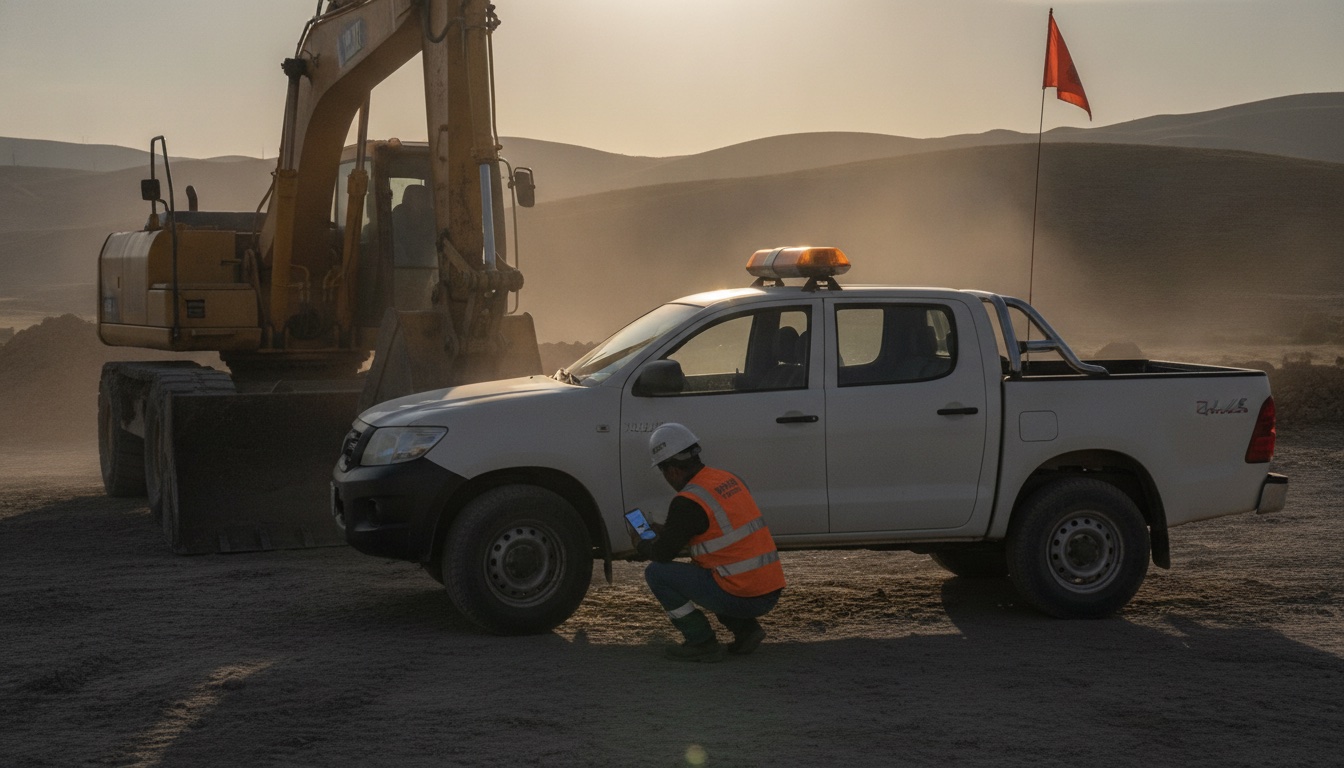
SSOMA · 7 min read · 2026-11-24
Pre-use checklist for pickups and equipment: what the rules require
Pre-use checklist for pickups and heavy equipment on construction and mining sites: what to check, what DS 024-2016-EM requires, how to close faults.
A pre-use checklist for pickups and heavy equipment is the inspection the operator runs before starting up, every shift, and signs. In Peruvian mining it's mandatory: DS 024-2016-EM requires the operator to inspect mobile equipment before putting it into operation each shift. On construction sites it's required by the project's safety plan and, almost always, by the client.
This guide is for the HSE manager, the equipment manager and the site supervisor who have to answer for that checklist when the audit comes. It covers what to check on a pickup and on heavy equipment, what the regulation says and doesn't, and why the problem is almost never the form itself.
What the regulation requires, article by article
In mining, article 378 of DS 024-2016-EM is the one that governs. Clause a) says the operator "shall carry out an inspection before putting it into operation in each work shift". It also says that if a defect shows up while the equipment is running, the operator must stop it and report it to their immediate supervisor "to correct the faults detected". Clauses b) and c) add two items every checklist needs: seat belts in good condition and a working automatic reverse alarm.
Article 140 covers the other half. Supervisors from both the mine operator and its contractors must run daily internal inspections at the start of each shift. The operator's check isn't enough on its own: someone in supervision has to see it the same day. DS 023-2017-EM amended several articles of that regulation, but not 140 or 378.
A point that trips many people up: DS 024 includes no pre-use form. Its annexes include forms for the continuous IPERC, the ATS (job safety analysis) and the PETAR (high-risk work permit), but no pre-use checklist. Each mine operator or contractor defines its own in its internal standard. That's why the same pickup may need a different checklist on every project.
In construction, DS 011-2019-TR requires the project's health and safety plan to include record forms and an inspection program (article 18). It also tasks the site safety subcommittee or supervisor with periodic inspections of machinery and equipment (article 39). The regulation doesn't prescribe the operator's daily check; the plan and the client contract do.
What to check on a pickup
The pickup is the most-used and least-checked vehicle on site, because "it's just a pickup". On a project with mountain climbs and dirt tracks, it's the one that puts the most people at risk. A 4x4 pickup checklist on a construction or mining site covers at least:
- Documents: mandatory insurance (SOAT), technical inspection, registration and the driver's internal license for that project.
- Tires: pressure, wear, cuts, and the spare with jack and wrench.
- Brakes: service and parking brake, tested before leaving.
- Lights: headlights, indicators, brake lights, reverse light and beacon.
- Fluid levels: oil, coolant, brake fluid and fuel.
- Safety: seat belts, reverse alarm, charged fire extinguisher, first-aid kit, cones or wheel chocks, and the whip flag if the client requires it.
- Cab: windshield free of cracks, mirrors, wipers and radio.
- Odometer: logged on departure, to cross-check against fuel use later.
What to check on heavy equipment
On an excavator, a loader or a dump truck, the check splits into three moments:
- Before starting: leaks under the machine, hydraulic hoses, structure and bolts, tires or tracks, bucket and teeth, fire extinguisher, steps and handrails.
- Engine running: no dashboard alarms, oil pressure, temperature, brakes, steering, horn and reverse alarm.
- The surroundings: stable ground, distance to slopes and power lines, no one on foot inside the swing radius.
- The hour meter: logged at the start. That number later backs up the equipment hours in the daily report.
If a critical item fails, the machine doesn't start. That's what article 378 requires, and it's the only thing that actually protects the operator.
Why a paper checklist protects no one
The form is almost never the problem. Nearly every project has a good one. The problem is what happens to the sheet after it's signed.
- It's filled in from memory. At 6:58, with the bus waiting, the operator ticks the whole "OK" column without getting out to look at the tire.
- It stays in the glovebox. The pad goes back to the office when it runs out, folded and dusty by then.
- The fault gets reported and no one closes it. The operator writes "reverse alarm not working". The sheet reaches the equipment manager three days later. Meanwhile, the machine kept working.
- It isn't there when it's asked for. The client's auditor asks for the dump truck's check from the 12th. Someone spends an afternoon going through binders, and the sheet isn't there.
- The supervisor doesn't see it in time. Article 140 requires the supervisor's daily inspection at the start of the shift. With paper, the supervisor sees the checks after the shift is over.
On a project with forty pickups and twenty machines, that adds up to sixty sheets per shift that no one reviews in time.
How to run pre-use checks on a phone
Moving the checklist to a phone doesn't change what gets checked. It changes what happens after:
- One check per machine per shift, with time and place. The photo of the tire or the leak stays attached to the flagged item, with its GPS stamp.
- Operator's digital signature. The supervisor sees in real time which machines have their check for the shift and which don't.
- Every fault has an owner. A failed item reaches the supervisor as soon as it's marked, not on Friday.
- Works without signal. In a pit or on a remote site, the check is saved on the phone and syncs when there's coverage.
- History is searchable in seconds. The check from the 12th comes out as a PDF, with photos and signature, and goes to the auditor by WhatsApp or email.
- Fields adapt to each project. Since the regulation doesn't set a format, each client asks for its own, and the checklist adapts.
That's how Logiflex Pre-Uso works: a pre-use checklist app for light vehicles and heavy equipment. It isn't available yet; you can sign up on its page to be notified at launch. It will have a free plan for one vehicle and a paid plan for the full fleet, with a supervisor view. It's one of the Logiflex field apps, alongside the daily report, where the hour meter from the check becomes equipment hours.
Frequently asked questions
Is a pre-use checklist mandatory in Peru?
In mining, yes. Article 378 of DS 024-2016-EM requires the operator to inspect mobile equipment before every shift. In construction, DS 011-2019-TR requires record forms and an inspection program in the project's health and safety plan, and the client usually requires the daily check by contract.
Which pre-use form does DS 024 require?
None in particular. The regulation includes forms for the continuous IPERC, the ATS and the PETAR, but not for pre-use checks. Each mine operator or contractor defines its own in its internal standard, so ask which fields the project's client requires.
Who signs a pickup's pre-use check?
The driver or operator who will use it that shift. The supervisor reviews it the same day: article 140 of DS 024 requires supervisors from the mine operator and its contractors to run daily internal inspections at the start of each shift.
What if the check finds a fault?
If it's a critical item (brakes, steering, seat belt, reverse alarm), the vehicle stays put and the fault goes to the supervisor. If the fault appears mid-operation, article 378 requires stopping the machine and reporting it immediately. What matters is that the fault is logged with a date and that someone closes it.
Is an Excel or PDF template enough?
It works to get started and for a small project. Once there are dozens of machines per shift, the problem stops being the template. It becomes who reviews the sheets, when each fault gets fixed, and where the check the auditor wants is.
Next step
If your project already has the form and the follow-up is what fails, see how Logiflex Pre-Uso will work and sign up for the launch. If you need pre-use checks connected to your equipment control, your daily report or your client's SAP, we build that around the operation in construction and mining. Let's talk.
More from the field
EPC · 7 min read
EPC pass-through and the contractor tech gap
Why mid-tier contractors operating under EPC inherit operational complexity their toolkit was never built for — and where the unowned middle of the LATAM software market sits.
Valorización · 6 min read
Why valorización contratista cycles eat your cash
A 5-day delay in the valorización cycle of a 5,000-worker contract under Anglo SAP can absorb a month of operating cash. The hidden cost of mapping every client format manually.