SSOMA · 8 min read · 2026-11-26
Continuous IPERC: form, filling, examples, and when ATS applies
Continuous IPERC explained: what Annex 7 of DS 024-2016-EM requires, how to fill it out step by step, an example, and when an ATS applies instead.
A continuous IPERC (IPERC continuo) is the hazard and risk analysis a crew carries out at the start of every task, at the work front itself, and that the supervisor confirms or corrects. In Peruvian mining it's mandatory: article 95 of DS 024-2016-EM requires it on the Annex 7 form, signed by every worker who takes part.
This guide is for the HSE manager, the supervisor and the foreman who have to answer for that form. It covers what the regulation requires, how to fill it out step by step, a worked example, and the most common mix-up among contractors working in a mine and on civil works at the same time: when you need a continuous IPERC and when you need an ATS (job safety analysis).
What the regulation requires
Article 95 of DS 024-2016-EM says that at the start of every task, workers identify hazards, assess risks and determine control measures "according to the continuous IPERC in Annex 7". Those measures "shall be ratified or modified by the responsible supervision". When more than two people work on a task, the continuous IPERC can be done as a team, and each worker records their participation with a signature.
Three more articles complete the picture:
- Article 96: controls follow this order: elimination, substitution, engineering controls, signage and administrative controls, and PPE last.
- Article 38: the supervisor must verify that the IPERC done by the workers in their area was complied with.
- Article 97: the baseline IPERC (Annex 8) is a different document. It's the project's risk matrix, updated every year and whenever processes or equipment change, a dangerous incident occurs or the law changes. The continuous IPERC is the daily one, and it brings that baseline down to the specific task.
Neither DS 023-2017-EM nor DS 034-2023-EM changed articles 95, 96 or 99, or Annex 7. What DS 034-2023-EM did widen is the scope: its article 2 lists civil construction, mechanical and electrical installation, camps, canteens and personnel transport among the activities related to mining that the regulation covers. If your project sits inside a mining unit, DS 024 applies.
Continuous IPERC or ATS: the difference that confuses people
In mining, the ATS doesn't replace the continuous IPERC. Article 99 of DS 024 reserves it for non-routine activities: those not in the baseline IPERC and with no written safe work procedure (PETS). For those, you fill out the ATS in Annex 11.
On civil works outside a mine, it's the other way around. DS 011-2019-TR, the construction safety regulation, doesn't mention a continuous IPERC. It requires the employer to define its IPERC method, update it continuously with the workers and keep it visible on site (articles 6.12 and 20). For day-to-day work, its article 55 requires the ATS: before an activity starts, the foreman and the workers prepare it "taking into account the results of the IPERC". The supervisor or foreman and the workers sign it, it's valid for the shift as long as conditions don't change, and at the end it goes to the site safety officer.
In short:
- In a mine, routine task: continuous IPERC (Annex 7), every day.
- In a mine, non-routine task with no PETS: ATS (Annex 11).
- On civil works outside a mine: the project IPERC as the baseline, and a daily ATS per activity.
A contractor with one crew in a pit and another on an urban project needs both forms, and its people need to know which one applies where.
How to fill out the continuous IPERC, step by step
Annex 7 is a one-page form. It groups the task details and the signed names of the people doing it, the assessment of each hazard with its risk level before and after controls (high, medium or low: A, M, B on the form), a space for the sequence of steps that controls the hazard, and a final block with the supervisor's details: the time of their review, the corrective measure they set, and their signature. Each mine operator adapts it to its own standard, but the order is the same:
- 1. Task details. Date, time, area or level, and the task stated concretely: "lifting 12-inch pipe with a boom truck on platform 3", not "general work".
- 2. Who's doing it. Name and signature of each crew member. With more than two, the IPERC can be a team one, but everyone signs.
- 3. Hazards at the spot, looking at the spot. Identified at the work front, not in the canteen. What's above, below and around, and what energy could be released.
- 4. The risk for each hazard. What could happen to a person: caught-in, falling load, struck-by, fall from height.
- 5. Risk level without controls. High, medium or low, using the basic severity-and-frequency matrix that comes with Annex 7 itself, or the project standard's.
- 6. Controls, in the article 96 order. First whatever eliminates or isolates the hazard; PPE comes last and is never the only control for a high risk.
- 7. Risk level with controls in place. If it's still high, the task doesn't start until another control is added or the method changes.
- 8. Supervisor review. They walk the front, confirm or correct, log the time and the corrective measure, and sign. Without that signature the IPERC is incomplete.
A worked example
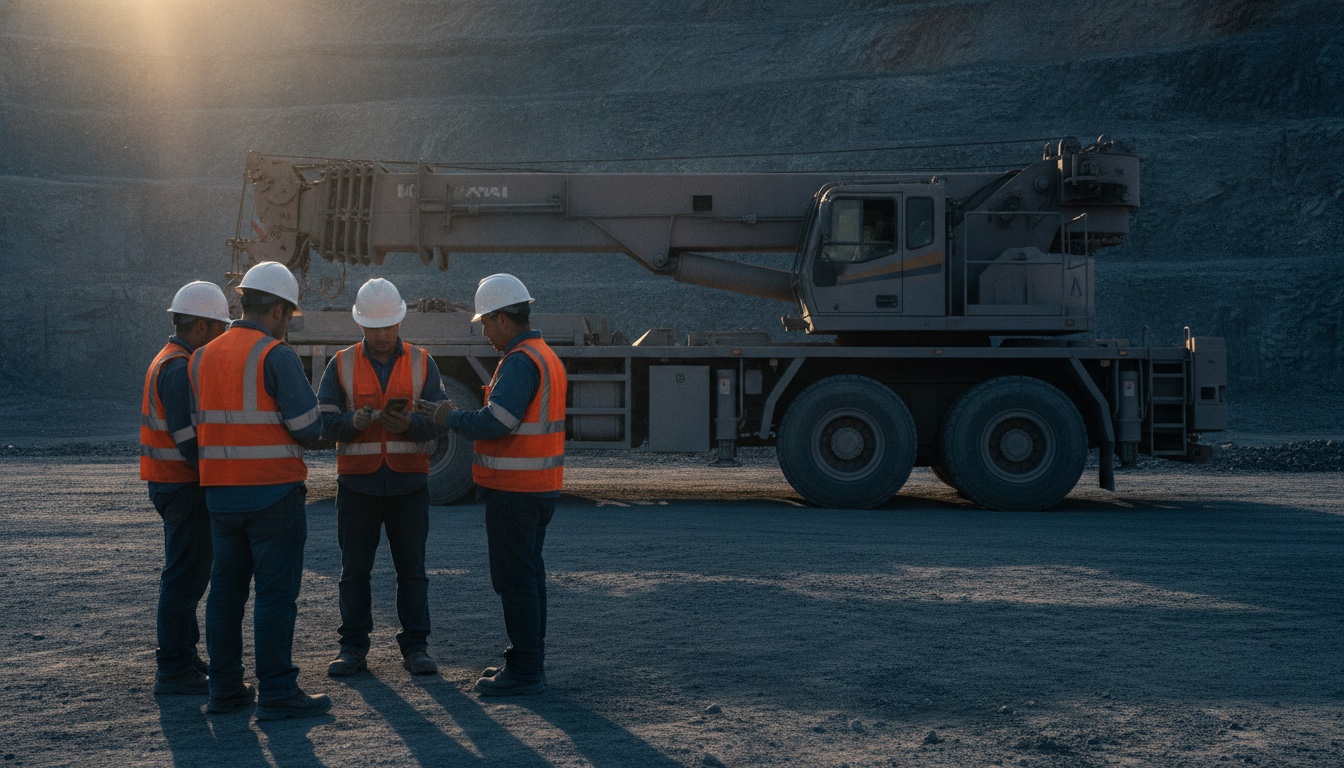
Task: lifting pipe with a boom truck on a work platform inside the mining unit. Crew of four: operator, rigger, spotter and helper.
- Hazard: suspended load. Risk: load falling on a person. Without controls: high. Controls: exclusion zone with cones and tape under the lifting radius, tag lines to guide the load, certified rigger, nobody under the load. With controls: low.
- Hazard: platform ground. Risk: crane tip-over. Without controls: high. Controls: outriggers fully extended on cribbing, compacted and level ground, load within the crane's chart. With controls: medium. The supervisor checks it before authorizing.
- Hazard: pickup traffic on the road beside the platform. Risk: being run over. Without controls: medium. Controls: spotter with a stop/slow paddle, signposted detour. With controls: low.
What can't be missing: the four names with signatures, the time, and the supervisor's signature. If a second crane arrives mid-task or it starts raining, conditions have changed and the IPERC is done again.
Why a paper continuous IPERC protects no one
Almost every project has a good form. The problem is what happens to the sheet:
- It's filled out by habit. Yesterday's IPERC, copied, with the date changed.
- It's filled out away from the front. At the start-of-shift talk, before anyone sees where the work will happen.
- The supervisor signs late. They have eight fronts and reach them all by mid-morning. By then the task is well underway.
- There's no way to know which fronts skipped it. Sheets reach the office at the end of the shift, or the end of the week.
- It can't be found when someone asks. The regulator or the client asks for crew X's IPERC from the 8th, and someone spends the afternoon in binders.
How to run the continuous IPERC on a phone
Moving it to a phone doesn't change what gets analyzed. It changes what happens next:
- Every IPERC carries a time stamp, a photo of the front and a location. You can see it was done on the spot.
- Every worker's signature and the supervisor's sit in the same record. The supervisor sees in real time which fronts have their IPERC and which don't, and confirms it from there.
- IPERC and ATS in the same app. The crew picks the form that fits the task without retyping their details.
- History is found in seconds. The IPERC from the 8th comes out as a PDF with signatures and photos.
That's how Logiflex IPERC + ATS works: one app for the continuous IPERC and the ATS, with photo and GPS evidence and a supervisor approval flow. It isn't available yet; you can sign up on its page to hear when it launches. It will have a free plan with five IPERCs and five ATSs a day. It belongs to the same family of field apps as the 5-minute safety talk and the pre-use checklist. For the baseline IPERC, with a hazard catalog and three-level approval, Logiflex IPERC is on the roadmap.
A real case: field inspections without paper
At UNNA Energía, with 6,726 workers and oversight from OSINERGMIN, OEFA and MTPE, field HSE inspections ran on paper forms with no photos. They moved to a field-capture app with photos, GPS and a real-time dashboard, and the paper forms were eliminated. Each module reached production in four weeks. It isn't an IPERC, but it's the same problem: a safety record that existed on paper and didn't work as evidence.
Frequently asked questions
What is a continuous IPERC?
It's the hazard identification, risk assessment and control measures that workers carry out at the start of each task, at the place where they'll do it. Article 95 of DS 024-2016-EM requires it, using the Annex 7 form, and the supervisor confirms or corrects it.
What's the difference between IPERC and ATS?
In mining, the continuous IPERC is the daily analysis for routine tasks, and the ATS is for non-routine tasks that aren't in the baseline IPERC and have no PETS (article 99 of DS 024). On civil works, DS 011-2019-TR requires the project IPERC as the baseline and a daily ATS per activity.
How often is the continuous IPERC done?
At the start of every task, every day. If conditions change mid-task (different equipment, rain, a new front), it's done again. The baseline IPERC, by contrast, is updated once a year and whenever processes change, a dangerous incident occurs or the law changes.
Who signs the continuous IPERC?
Every worker doing the task, plus the responsible supervisor, who confirms or modifies the controls. If more than two people are on the task, it can be done as a team, but each of them signs.
Does an Excel continuous IPERC template work?
It works for printing and filling out by hand at the front. What Excel doesn't solve is knowing, at 8 a.m., which crews skipped it, or finding the one from a given date when the regulator asks.
Next step
If your project already has the form and the problem is getting it filled out at the front and seen by the supervisor in time, see how Logiflex IPERC + ATS will work and sign up for the launch. If you need the IPERC tied to your baseline matrix, your PETS or your mining client's standard, that gets built on top of your project's operation, in mining and in construction. Let's talk.
More from the field
Roster · 8 min read
Construction crew timesheet (tareo) in Excel: columns, filling, limits
Construction crew timesheet (tareo) in Excel: the columns, filling it by cost item, why it isn't the attendance record, and when Excel falls short.
SSOMA · 7 min read
Pre-use checklist for pickups and equipment: what the rules require
Pre-use checklist for pickups and heavy equipment on construction and mining sites: what to check, what DS 024-2016-EM requires, how to close faults.